Friday, August 7, 2009

Obama Chia Pet: Racist?

clip_image002[6]

clip_image004[6]

I don’t know how I missed this one, but when I was recently informed about the Obama chia pet I had to put my two cents in.

A bit ago, Joseph Enterprises—the originators of the chia pet—announced their Obama chia models, seen in their copyrighted images on the right.

With this new chia tribute, Obama finds himself in company with a young Dean Stockwell (see the poster at lower right) countless extras from Star Trek, and—as you will see below—one of the most famous and respected  scientists of the twentieth century.

There are two Obama chia models: The “Determined” chia Obama, who looks far more confused than decisive, and the “Happy” chia Obama, which—I think—looks more like Scatman Crothers caught with his hand in the cookie jar.

image

However—what with all the Obama lunacy mania—I’m sure there are thousands of people who would want one one of these adorable little terra-cotta wonders brightening up an otherwise dark, dismal cubicle at, say, General Motors or the Federal Reserve.

But not the folks at Walgreens, who pulled the Obama pets from their stores.

According to Walgreens’ spokesman Robert Elfinger:

We got some complaints from people that they thought it was racist.

(Am I wrong or should a corporate spokesman not sound like a bookie?)

What?

Racist?

Read my article, Racist Russian Ad Features Obama—that my friends, is racist.

We’re talking about a chia pet here, not an effigy being burned on the streets of Tehran.

image

Image Copyright © Joseph Enterprises, Inc.

To the right, you will see another popular chia pet called “The Professor” but obviously a characterization of…

Come on now, lets not always see the same hands…

That’s right, Johnny—it’s Albert Einstein!

So—by extenuation—I suppose an Einstein chia pet is anti-Semitic?

Joseph Pedott, president of Joseph Enterprises and a Republican who voted for Obama, said he was stung by suggestions that there was something racist about Chia Obama, which, if left untrimmed, appears to give the 44th President a healthy, if very green, Afro.

“It's already a top seller and could be the biggest I have ever had," Pedott said. "Since when is an Afro racist?" he asked. “Owners can trim Chia Obama's ‘hair’ to any length they want.”

Imagine that: Barber…or, perhaps…gardener to the President! Wow!

image

Richard Nixon mask:
Anti-Quaker?

So why the controversy?

Could it be that some people are themselves racist and use every piddling, insignificant opportunity they can find to drop the” race card” on whitey?

Easy to find out, let’s all chip in, send an Obama pet to Al Sharpton and watch the seismometers.

I, myself, would be honored if Joseph Enterprises were to offer a chia in my likeness, green afro and all.

They would, of course, have to leave a blank patch on top to represent my bald spot.

Thursday, August 6, 2009

Baucus Skips Fundraiser for His Glacier ‘PAC’, A Popular Place for Health Industry Contributions

image

This past weekend Sen. Max Baucus’ political action committee (PAC) hosted a three-day retreat fundraising event at the Big Sky Resort with “fly-fishing in three nearby rivers, golfing on an Arnold Palmer-designed course, horseback riding and hiking, family fun and gorgeous scenery.” The entrance fee for the event was $2,500 per individual and $5,000 for a PAC. While the roster of interest groups, lobbyists and other individuals in attendance is unknown at this time, we do know who was a no-show: Max Baucus.

According to the National Journal’s Under the Influence blog, Sen. Baucus announced his intention to avoid the event before the fundraiser commenced to “tend to faltering bipartisan negotiations over health care reform legislation.” The senator will not only be missing those who want his ear on a variety of issues coming before his powerful committee — cap and trade and health care — he’ll also be missing a protest held by advocates for single payer health care.

Despite missing this fundraiser, the Montana senator’s Glacier PAC has already pulled in large sums of money from the health and insurance sector and lobbyists representing both sectors. Since January, Baucus’ Glacier PAC has raised $99,500 from health and insurance PACs and lobbyists representing health and insurance organizations. This represents one-third of all contributions to Glacier PAC this year.

Many of these contributions were filed with his committee in the days soon after other fundraising weekends in the mountains of Montana.

Over the weekend of February 6, Baucus hosted his Eighth Annual Ski and Snow Mobile Weekend, a fundraising weekend get-away much like the July 31-Aug 2 event that Baucus skipped. Contributions that were filed on February 16 include four health care PACs and two lobbyists for health care companies.

The PACs included National Emergency Medicine PAC, Sanofi-Pasteur, American College of Cardiology and American College of Radiology Association.

Three out of these four PACs contributed the maximum $5,000 with Sanofi-Pasteur contributing $2,500.

The lobbyists included Tracy Spicer (Aetna, Blue Cross/Blue Shield, Bravo Health, Healthcare Leadership Council, Heritage Services, Medco, National Health Policy Group, Travelers Companies, UnitedHealth Group) and William Oldaker (Adventist Health Systems, Healthcare Quality Strategies, Intermountain Health Care, Iowa Foundation for Medical Care, IPRO, Lumetra, Mpro, Ohio KePRO, Parexel International, TMF Health Quality Institute, West Virginia Medical Institute).

Contributors to Sen. Baucus’ Glacier PAC also include some of his former staffers now lobbying for health care organizations.

These include former chief of staff David Castagnetti ($3,000), Nick Giordano ($1,000) and Roger Blauwet ($2,500). Castagnetti represents a wide array of health care companies including America’s Health Insurance Plans (AHIP), American College of Cardiologists, Abbott Laboratories, AstraZeneca, Proctor & Gamble and Merck. Blauwet represents Merck, Wyeth, Rx Benefits Coalition and the Association of Financial Guaranty Insurers. Giordano is listed in reports as representing Covidien, Health Care Service Corporation, Johnson & Johnson, McKesson Corporation, Milliman Care Guidelines and the National Association of Public Hospitals.

Many of these organizations have also made PAC contributions to the senator’s Glacier PAC.

While Sen. Baucus has promised not to accept any more contributions from health care PACs, he is still willing to accept contributions from their lobbyists and executives. It will be interesting to see who showed up at the senator’s big summer weekend getaway, even if the senator didn’t make it there himself.

Full list of health and insurance PAC and lobbyist contributions below:

Glacier PAC Contributions 2009 (Health and Insurance PACs and Lobbyists):

PACs

American Society of Anesthesiologists

$5,000.00

01/05/09

National Emergency Medicine

$5,000.00

02/16/09

Sanofi-Pasteur

$2,500.00

02/16/09

American College of Cardiology

$5,000.00

02/16/09

American College of Radiology Association

$5,000.00

02/16/09

Pacific Pulmonary Services

$5,000.00

03/09/09

Merck

$5,000.00

03/20/09

Boston Scientific Corp

$5,000.00

03/31/09

American Podiatric Medical Association

$5,000.00

04/27/09

College of American Pathologists

$5,000.00

04/27/09

American Dental PAC

$1,000.00

05/01/09

Medtronic

$2,500.00

05/08/09

Schering-Plough

$5,000.00

05/08/09

American Chiropractic Association

$2,500.00

05/08/09

Aetna

$5,000.00

05/11/09

Torchmark

$5,000.00

06/04/09

Independent Insurance Agents of America

$5,000.00

06/30/09

Lobbyists


Tracy Spicer

$2,000.00

02/16/09

William Oldaker

$5,000.00

02/16/09

Jonathan Slade

$1,000.00

03/09/09

David Jory

$2,000.00

03/09/09

J Curtis Rich

$1,000.00

03/09/09

David Castagnetti

$3,000.00

03/31/09

Eric Hanson

$5,000.00

05/08/09

Billy Wynne

$1,000.00

05/18/09

Nick Giordano

$1,000.00

05/26/09

Roger Blauwet

$2,500.00

06/04/09

Geoffrey Peterson

$1,500.00

06/30/09

Nance Guenther-Peterson

$1,000.00

06/30/09

See Paul Blumenthal’s original article here.

Senator Roberts Tries To Derail Senate Transparency Bill

Roberts’ amendment would illegally intimidate non-profit organizations, stifle ethics complaints against senators

With the U.S. Senate winding down to take its annual August recess, maybe lawmakers want to show constituents some full-throated support for disclosure before they leave?

Ten government transparency groups, including the Center for Responsive Politics, are hoping senators will soon pass a bill to bring them up to speed with their counterparts in the U.S. House and those who run for president.

Unlike candidates for president and for the House, senators still file campaign finance reports on paper rather than electronically—meaning it can take weeks, if not months, to fully know what interests are bribing backing them.

The “Senate Campaign Disclosure Parity Act” (S. 482) would finally provide electronic filing for Senate candidates.

It has strong support from both parties, but Senator Pat Roberts (R-KS.) is playing politics by blocking the bill from moving forward – no doubt wearing his hat as chairman and fundraiser-in-chief for the National Republican Senatorial Committee.

While Roberts claims to support the bill, in reality he is trying to kill it by attaching an irrelevant amendment which would force non-profit organizations to expose their members and donors when they file ethics complaints against senators. This tactic has been used in the past to intimidate and is clearly unconstitutional.

Please call your senators today urging them to pass S. 482, establishing electronic filing for senate campaign finance records, and to oppose Senator Roberts’ ghastly amendment designed to derail the campaign finance reporting measure.

Out-of-State Donations Flow To Many Members Of Congress

Up to 100% of bribes donations to politicians are not from their constituents

A U.S. senator represents—ostensibly—just a single state. But that doesn't always mean his or her financial support comes from it.

Consider Senator Max Baucus (D-Mont.), the chair of the powerful Senate Finance Committee at the center of the nation's debate over health care reform. While he's reported more than 100 campaign contributions from individuals exceeding $200 so far this year—about $108,000 in all—not one such donation has come from a resident of Montana.

In this respect, Baucus is not alone. Several other members of Congress' upper chamber have heavily relied upon out-of-state donors to fill their war chests during the first six months of the year.

But all of these senators fall at an extreme end of the spectrum: Senators, on average, raised 57 percent of their individual contributions from out-of-staters during the first six months of 2009, according to a Center for Responsive Politics analysis of Federal Election Commission records. (The FEC only requires candidates to itemize donations of $200 or more.)

Senators raising a large percentage of funds from out-of-state interests typically hail from states with small populations.

Among them: Senator Byron Dorgan (D-N.D.), who is up for election next year. He raised about $1.1 million during the first six months of 2009 from individuals who contributed more than $200. Of that sum, 99 percent came from out-of-state donors.

Only Senators Harry Reid (D-Nev.) and Chris Dodd (D-Conn.) raised more cash from individual itemized donors than Dorgan during the first six months of the year. Each of these high-profile lawmakers is facing a contentious reelection.

For his part, Reid, the majority leader, raised about $6.6 million, with 86 percent coming from out-of-state donors. And Dodd—who was among the top recipients of out-of-state cash last quarter, and who raised eyebrows after reporting just five contributions from in-state residents during the first three months of 2009 -- raised about $1.3 million, with 91 percent coming from out-of-staters.

Two other members of both the Senate Finance Committee and Baucus' "coalition of the willing" that is crafting a draft of health reform legislation for that committee also rank among the top recipients of out-of-state individual contributions.

North Dakota's senior senator, Kent Conrad, who is also a Democrat, raised $51,600, with 96 percent coming from out-of-staters. And Senator Chuck Grassley (R-Iowa), who is also up for election next year, raised $72,600, with 99 percent of that coming from out-of-state donors.

On the other end of the spectrum, only Senator Lamar Alexander (R-Tenn.) stands out. Alexander, who was re-elected last fall, raised $27,000 from individual donors during the first six months of 2009, with fully 100 percent of those contributions coming from residents of Tennessee.

On the House side, CRP has found that donations are more likely to flow from in-state residents. Members of the U.S. House of Representatives raised a median of 77 percent of their individual contributions from in-state donors.

But many Congressmen who have raised large sums so far this year have not seen cash from constituents alone.

Representative James Oberstar (D-Minn.), chair of the Transportation Committee, raised $262,000 during the first half of the year from individual donors -- with every penny of his individual donations of $200 or more coming in from out of state.

Representative Keith Ellison (D-Minn.), the first Muslim elected to Congress, raised $189,700, with 80 percent coming from out-of-state donors. And Representative Steny Hoyer (D-Md.), the majority leader in the House, raised about $236,200, with 72 percent coming from out-of-state donors.

Two other Democratic Congressmen who have raised all of their individual contributions from out-of-state residents include Representatives John Conyers (D-Mich.) and Pete Visclosky (D-Ind.). Conyers, chair of the Judiciary Committee, raised about $41,100 during the first six months of the year. And Visclosky, who has made headlines because of his close connections to lobby shop PMA Group that the FBI is investigating, raised $40,550.

Some high-profile Republicans have also been on the receiving end of out-of-state money.

Roughly two-thirds of the individual donations to Representative Eric Cantor (R-Va.) and Representative Joseph Cao (R-La.) have been out-of-staters.

Cantor, the minority whip, raised $450,900 during the first six months of 2009, while Cao, the first Vietnamese-American to serve in Congress after beating legally troubled Democratic Rep. William Jefferson, raised about $320,200.

Among Republican Congressmen who received 100 percent of their individual donations from out-of-staters were Representative Spencer Bachus (R-Ala.), ranking member of the Financial Services Committee, who raised $27,950, and Representative Dan Burton (R-Ind.), who raised about $49,900.

Dig into the geographical analysis yourself by examining these spreadsheets. Please note the multiple tabs for lists of the top recipients of in-state and out-of-state individual contributions, by dollar amount and by percentage. Tables also exist for the second quarter alone, as well as for the entire first six months of 2009. If you use our data, please be sure to credit CRP. Geographical Donations 09.xls

Original by Michael Beckel may be viewed here. CRP Senior Researcher Douglas Weber contributed to this report.

See this reference for definitions of “influence peddling.”

See this reference for definitions of “bribery.”

Rep. William Jefferson, convicted of corruption, received handsome donations from legal community

williamjefferson.jpg

William Jefferson, convict and treasonous pig

Former U.S. Rep. William Jefferson (D-La.) is a newly infamous scofflaw who now faces spending decades in prison after a federal jury Wednesday convicted him of 11 counts of racketeering, solicitation of bribery and money laundering.

An ironic footnote: Lawyers and law firms were by far Jefferson's largest campaign donors during his now ruined congressional career, which began in 1990 when he became Louisiana's first elected black congressman since Reconstruction. That career ended unceremoniously in December when the embattled politico lost reelection to a poorly funded and relatively unknown Republican, Joseph Cao.

As an industry, lawyers and law firms donated more than $612,000 to Jefferson during his congressional career, according to a Center for Responsive Politics analysis. That significantly outpaces Jefferson's second-highest donor by industry -- public sector unions, at more than $257,000 over time.

Building trade unions ($233,300), health professionals ($193,885) and transportation unions ($191,700) round out the top five industry contributors to Jefferson's congressional campaigns.

The American Association for Justice ranks as Jefferson's all-time contributor by organization, sending him $73,500 during his congressional career. The American Federation of Teachers and International Brotherhood of Electrical Workers follow closely behind.

Even during the 2008 election cycle, when Jefferson faced federal allegations that he oddly stuffed $90,000 worth of bribe money in a freezer (among a host of other misdeeds), lawyers donated $15,100 to the embattled congressman.

Eleven congressional leadership PACs also made donations to Jefferson during the 2008 election cycle, totaling $51,000. They include Rep. Bennie Thompson's Secure PAC ($14,000), Rep. James Clyburn's BRIDGE PAC ($10,000) and Rep. Gregory Meeks' Build America PAC ($6,500).

Separately last election cycle, the Congressional Black Caucus PAC reported donating $15,000 to Jefferson, and 22 congressional candidate committees also logged contributions to him.

Today, Jefferson remains free on bond. His lawyer told the Associated Press that Jefferson would appeal his convictions.

This article is by Dave Levinthal, the original may be viewed here.

Trillions Of Dollars To Be Wasted On Bad Science?

Will politicians’ foolish reliance on faulty “global warming” models will cost you and your children a staggering fortune?
This article is the appendix of a paper by William Gray, emeritus professor of atmospheric science at Colorado State University, on the paper titled:

On The Hijacking of the American Meteorological Society (AMS)
(Scientific Discussion)


ABSTRACT
I am presently preparing a lengthy research paper to back up my low estimates of the potential for human-induced global warming resulting from a doubling of CO2. This Appendix attempts to show that only a very small amount of the global warming that has been observed over the last century and since the mid-1970s can be attributed to global CO2 increases. A second paper with yet more scientific documentation will hopefully be ready in another couple of months.
A doubling of CO2 would lead to a global infrared (IR) energy blockage to space (all other processes held constant) of about 3.7 W/m2. We are about one-third (~1.2 W/m2) of the way to a CO2 doubling from the pre-industrial state. The balancing of the 1.2 W/m2 energy gain from CO2 increase that has so far occurred would lead to an upper tropospheric emission temperature increase of about 0.3oC and a corresponding surface temperature increase of about 0.15oC. This is less than a quarter of the ~0.7oC global temperature increase that has been observed since the start of the industrial revolution. Processes more dominant than CO2 increases had to be responsible for most of the global warming that has occurred.
The globe has continuous solar energy absorption of about 235 W/m2 which is balanced by continuous infrared (IR) energy emittance to space of 235 W/m2. This continuous in-and-out energy flux is 200 times greater than the accumulated current CO2 induced energy gain from the mid-19th century. Long period infrared and albedo energy changes resulting from naturally occurring differences in global rainfall, cloudiness, surface sensible flux, deep ocean current changes, etc. can be considerable greater than this relatively small and gradual 1.2 W/m2 global infrared energy suppression to space. Yes, increases in CO2 are causing global warming, but very little of it. Too little to justify a sizable reduction of our society’s use of fossil-fuels for the far more expensive employment of renewable energy.
This Appendix discusses how the variation in the global ocean’s deep circulation resulting from changes in the Atlantic Thermohaline Circulation (THC) and/or the associated ocean Meridional Overturning Circulation (MOC) is the likely cause of most of the global warming that has been observed since the start of the industrial revolution and the more recent global warming that has occurred since the mid-1970s. Changes of the MOC since 1995 are hypothesized to have lead to the cessation of global warming since 1999 and to the beginning of a weak global cooling that has occurred since 2001. This weak cooling is projected to go on for the next couple of decades.

1. INTRODUCTION
There are about 20 different General Circulation Model (GCM) groups around the world that have been conducting extensive numerical modeling simulations of the likely changes in global mean temperature that should be expected to occur from a doubling of atmospheric carbon dioxide (CO2) gas. Carbon dioxide has so far risen about 33 percent (to 385 ppm) over its pre-industrial values and about 15 percent during the last 30 years. It is expected that there will be a doubling of atmospheric CO2 by the latter part of the 21st century. Most of these GCM simulations indicate that there will be a 2-5oC (4-9oF) increase in global mean temperature by the time this doubling takes place if there is no action to reduce these CO2 increases. Such large warming would cause great changes in human society. These large warming scenarios are highly unlikely, however. The GCMs greatly exaggerate the potential warming that will occur. These exaggerations are due to:
  1. Models assuming that an increase in atmospheric CO2 will cause weak global warming and an increase in global precipitation that will lead to a large increase in upper-level water vapor and cloudiness. They simulate that this increase in water vapor and cloudiness will block large amounts of infrared radiation emitted to space. New observations by satellite and reanalysis data however, do not support these GCM model assumptions. The global warming that has occurred since the mid-1970s has been associated with a general decrease of global upper tropospheric water vapor and an increase of Outgoing Longwave Radiation (OLR) to space. These measurements are opposite to what the models predict.
  1. GCMs do not currently model (or if they do – not accurately) the globe’s deep-water ocean circulation. Accurately modeling the global ocean’s deep circulation is fundamental to any realistic understanding of global temperature change. Such global deep water circulation patterns appear to be the primary control of global surface temperature. The global warming we have seen since the mid-1970s and over the last 100 years is largely due to reductions in the rate of global ocean deep water circulation (or Meridional Overturning Circulation – MOC) which is viewed as being driven by global ocean salinity variations. CO2 changes play no role in these ocean changes.
Recent GCM global warming scenarios assume that a slightly stronger hydrologic cycle (due to the increase in CO2) will cause additional upper-level tropospheric water vapor and cloudiness. Such vapor-cloudiness increases are assumed to allow the small initial warming due to increased CO2 to be unrealistically multiplied 3-5 or more times. This is where most of the global warming from the GCMs comes from – not the warming resulting from the CO2 increase by itself but the large extra warming due to the assumed increase of upper tropospheric water vapor and cloudiness. As CO2 increases, it does not follow that the net global upper-level water vapor and cloudiness will increase very much, certainly not anything like the amount projected by the GCM climate simulations. Observations of upper tropospheric water vapor over the last 3-4 decades from the NOAA-NCEP reanalysis show that upper tropospheric water vapor undergoes a small decrease and that Outgoing Longwave Radiation (OLR) undergoes an increase. This is opposite to what has been programmed into the GCM models. The predicted large global warming of the GCMs should thus not be taken to be credible.


2. OTHER GCM PROBLEMS

Small-Scale Problems. In order to integrate over the entire globe and many years into the future it is necessary that the GCMs have rather large grid spacing. This requires that the GCMs employ sub-grid scale cumulus parameterization schemes which can often be poor approximations of the real-world complex, non-linear small-scale cumulus convective processes. An important deficiency in the global models is the large amount of compensating up-and-down motion occurring between grid spaces that cannot be explicitly resolved by the models (Figure 1). These poorly-resolved approximations of sub-grid scale processes are integrated by the models for hundreds of thousands of time steps into the future. This guarantees large errors. Realistic sub-grid scale parameterization schemes have yet to be developed. Most GCM modelers are unfamiliar with the detailed functioning of the hydrologic cycle. Their models assume that changes in lower and upper tropospheric water vapor occur simultaneously which the observations do not verify (Figure 2). Observations show, in fact, that as global warming has occurred since the mid-1970s that lower tropospheric water vapor has increased while upper tropospheric water vapor has decreased. This appears to be a result of there being somewhat more deep Cb convection and a higher rainfall efficiency when the globe is warmer than when it is colder. There are slightly more deep convection updrafts and compensation mass subsidence drying during times when the globe is warmer.
Much research on the small scale parameterization of cumulus convection in terms of the large scale circulation patterns was done in the 1970s and 1980s without satisfactory resolution. The topic was too complex to be resolved during this period. To move forward the GCM models primarily ignored this difficult task. They chose not to get ‘down-in-the-trenches’ on such a complex topic. They accepted a few simple compromised schemes (with known problems) and went forward with their broader-scale modeling integrations assuming that their sub-grid schemes were ‘good enough’ or that the errors would average out in the end. But the sub-grid scale approximations they have used have not been good enough and the sub-grid parameterization errors do not average out over the long integration periods.
There are many large and complicated variations as to how sub-grid scale cumulus parameterization should be accomplished with respect to differences in latitude, land, sea, season, and other conditions. There are no general sub-grid parameterization schemes that can perform this function within the various global regions and on the long climate time-scales. And there will likely never be a satisfactory scheme.
clip_image002

Figure 1. Idealized portrayal of how the grid size of the GCMs is too large to accommodate real sub-grid scale vertical motion. GCMs cannot resolve (top) the concentrated rain or the surrounding cloud downdrafts and subsidence within the scale of its grid space (bottom). The top and bottom diagrams contrast the mean vertical motion of the GCM (top) and the real up-and-down vertical motion of nature if deep convection is occurring within a grid space. Note that the unresolved vertical motion of the top diagram allows less OLR to escape to space – than the bottom actual representation.

clip_image004
Figure 2. Comparison of correlation coefficient between upper and lower level tropospheric water vapor of the typical GCMs model output (red) and that of the Rawinsonde-reanalysis observations (blue line). The GCM model outputs are programmed to have a simultaneous moistening of the lower and upper tropospheric levels, but the observations of upper vs. lower troposphere moisture shows little correlation. This high correlation of the models causes them to artificially moisten the upper troposphere and block too much OLR to space. Adapted from Sun and Held 1996.
The net effect of the GCM’s sub-grid scale parameterization schemes is to underestimate sub-grid subsidence drying, and to unrealistically suppress OLR to space. This is one of the ways the GCMs are able to develop their large amounts of artificial warming. It is thus not so surprising that the GCMs produce so much global warming (~2 to 5oC) for only a relatively small increase (3.7 W/m2) of suppressed radiation to space for a doubling of CO2.
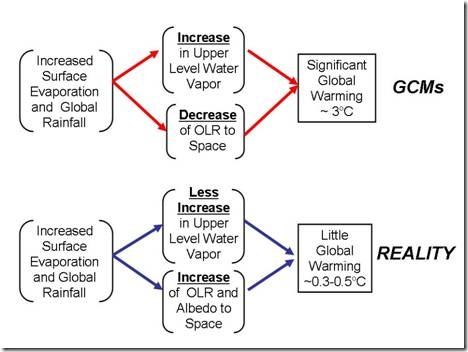
It is expected that global rainfall will increase somewhat as human-induced greenhouse gases increase. This increased rainfall is expected to primarily manifest itself in small amounts of increased and concentrated deep cumulus convection and increased rainfall efficiency in the normal areas where deep convection and rainfall are already occurring. This somewhat greater and more concentrated rainfall will not bring about global upper-level water vapor and cloud increase anywhere near as much as the GCM modelers have assumed. The diagram of Figure 3 gives the author’s concept of how the globe will handle a doubling of CO2 by the end of the 21st century. We will not see a global warming of 2-5oC as the GCM models indicate but rather a much more modest warming of about 0.3-0.5oC.
Albedo Considerations. Analysis of OLR and albedo from the new ISCCP (International Satellite Cloud Climatology Project – 1984-2005) for differing reanalysis determined rainfall amounts shows that at the places and times where rainfall increases that albedo goes up more than OLR goes down. There is thus more net short and long wave energy going to space in periods of increased rainfall than with decreased rainfall conditions. These observations do not agree with the programmed physics within the GCMs.
clip_image006

Figure 3. A view of the physical process differences between the global warming for a doubling of CO2 from the GCM climate models and reality.


Positive Water Vapor Feedback. Most geophysical systems react to forced imbalances by developing responses which oppose and weaken the initial forced imbalance; hence, a negative feedback response. Recent GCM global warming scenarios go counter to the foregoing in hypothesizing a positive feedback loop. This positive water vapor feedback assumption allows the small initial warming due to human-induced CO2 increases to be unrealistically multiplied 3-5 or more times. As AGW gases increase it does not follow that upper-level water vapor and cloudiness will increase very much. Observations indicate that the specific humidity and relative humidity of the middle and upper troposphere has been going down over the last 4-5 decades (Figure 4). The assumed positive water vapor increase with temperature as programmed into the GCM models does occur however at the surface and the lower troposphere. But this simultaneous increase of temperature and water vapor is not found in the upper troposphere near the radiation emission level. It is not the total precipitable water which is most important (measurements show this goes up with temperature) but rather the amount of water vapor near the upper tropospheric emission level which is important. This specifies the amount of infrared energy going to space.
clip_image008


Figure 4. The NOAA-NCEP reanalysis of standardized anomalies of 400 mb (~7.5 km altitude) water vapor content (i.e. specific humidity – in blue) and Outgoing Longwave Radiation (OLR) from 1950-2008. Note the downward trend in moisture and the upward trend in OLR.


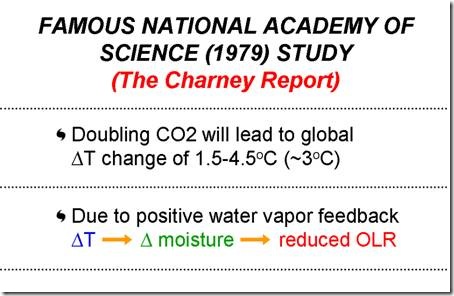
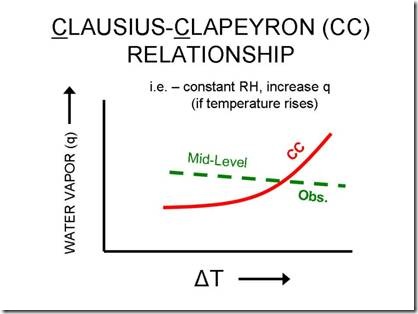
Faulty Reasoning Behind Climate GCMs. A basic assumption error behind the global GCMs has been the model builder’s general belief in the physics of the National Academy of Science (NAS) 1979 study – often referred to as The Charney Report. This report hypothesized that a doubling of atmospheric CO2 would bring about a general warming of the globe’s mean temperature between 1.5 – 4.5oC (or an average of ~ 3.0oC). This was based on the report’s assumption that the relative humidity (RH) of the atmosphere should be expected to remain quasi-constant if the globe’s temperature were to increase. The fundamental law of the Clausius-Clapeyron (CC) equation specifies that as the temperature of the air rises its ability to hold water vapor goes up exponentially. If relative humidity (RH) were to remain constant as atmospheric temperature rose then the water vapor (q) amount in the atmosphere would accordingly rise (Figure 5 and Figure 6). Observations show that this is indeed a valid assumption for the lower tropospheric levels but does not observationally apply in the upper troposphere (300-400 mb) where water vapor and relative humidity have been observed to slightly decrease as the atmospheric temperatures rises. Lower RH and reduced water vapor contents near the upper radiation emission level will act to increase the amount of outgoing longwave radiation (OLR) which will be emitted to space. By contrast, the GCMs have programmed a reduction of OLR for rising upper level temperature.
The global general circulation models (GCMs) which test the influence of CO2 increases, have accepted the hypothesized NAS – Charney Report (1979) scenario. Some of the GCM modelers such as the early NASA-GISS (Hansen 1988) model have even gone further than the Clausius-Clapeyron equation would specify for water vapor increasing with temperature. Hansen’s early GISS model assumed that a doubling of CO2 would cause the upper tropospheric RH not just to stay constant but to actually increase. And his assumed upper tropospheric increase of water vapor (q) for a doubling of CO2 led to a water vapor increase (∆q) in the upper troposphere of as much as an extremely unlikely 50 percent. These large vapor increases caused Hansen to require that his model have a tropical (30oN-30oS) upper tropospheric warming for a doubling of CO2 as much as 7oC (Figure 8). No wonder Hansen got such high values of global warming for a doubling of CO2. This logically followed from his extremely high water vapor assumptions.

clip_image010


Figure 5. The very influential NAS report of 1979 which deduced that any warming of the globe would occur with near constant relative humidity (RH). Global warming consequently causes an increase in atmospheric water vapor (q) and decrease outgoing longwave radiation (OLR). This assumption appears valid in the lower troposphere but no the upper troposphere.
clip_image012
Figure 6. Clausius-Clapeyron (CC) relationship showing the required increase of water vapor as temperature increases at constant relative humidity (RH) – red line. The observations of upper tropospheric water vapor – green dashed line – do not follow this theoretical relationship. This is likely a result of a warmer climate causing more deep convection and more return flow dryer subsidence.
clip_image014


Figure 7. James Hansen’s early GISS showing his assumed increases in specific humidity (q) and RH for a doubling of CO2. Such water vapor assumptions are completely unrealistic.

clip_image016

Figure 8. North-South vertical-cross section showing Hansen’s early GCM’s model change in temperature (oC) that would accompany a doubling of atmospheric CO2. There is no way a doubling of CO2 and an extra 3.7 W/m2 blockage of OLR to space could lead to such extreme upper tropospheric temperature rises. These large temperature increases occurred because of Hansen’s unrealistic upper level water vapor assumptions.
In order to obtain the global balance of incoming and outgoing radiation for his assumed high values of upper tropospheric water vapor it was necessary for Hansen to unrealistically raise his model’s upper tropospheric temperatures to obtain the amounts of Outgoing Longwave Radiation (OLR or σT4) to space that would accomplish net radiation balance. It is amazing that Hansen’s high water vapor increase assumptions for a doubling of CO2 were not immediately challenged.
It was these large amounts of warming resulting from his model’s gross over-estimate of water vapor which Hansen presented to a US Senate Committee hearing at the request of then Senator Al Gore during the hot summer of 1988. The media and much of the general public accepted it all. The environmentalists salivated. Hansen had secured his place in the sun. But history will reverse such adulation when his warming predictions are inevitable proven to be wrong.
Not only have Hansen’s extreme and unrealistic high values of upper tropospheric moisture and temperature changes (for a doubling of CO2) not been challenged, they were instead closely emulated by most of the other prominent GCM early global warming modeling groups of NOAA-GFDL (Figure 9), NCAR (Figure 10) and the British Met Service (Figure 11). They all followed suit and incorporated unrealistically high amounts of upper tropospheric water vapor and, as a result, obtained unrealistic high values of global upper and surface temperature just as Hansen had.
I am sure that the more recent global climate models of Hansen’s GISS model and the more recent, GFDL, NCAR and UKMET models have been improved. I expect the current set of GCM modelers will say I am referring to older model runs that are now obsolete. This argument does not hold however. If the more recent year models are superior to the older ones, then we would be seeing a revision downward of their warming estimates. But their newer models give much the same magnitude of warming as their older ones.
clip_image018
Figure 9. Same as Figure 8 but for early model NOAA-GFDL GCM temperature rises for a doubling of CO2.
clip_image020


Figure 10. Same as Figure 8 but for NCAR’s early model GCM temperature rises for a doubling of CO2.

NASA Announces $1.5 Million ‘Green’ Aircraft Challenge

The NASA Innovative Partnerships Program and the Comparative Aircraft Flight Efficiency (CAFE) Foundation today announced the Green Flight Challenge. The contest is a flight efficiency competition for aircraft that can average at least 100 mph on a 200-mile flight while achieving greater than 200 passenger miles per gallon.

The prize for the aircraft with the best performance is $1.5 million. The competition is scheduled for July 2011 at the Charles M. Schulz Sonoma County Airport in Santa Rosa, CA. A variety of innovative experimental aircraft using electrical, solar, bio-fuel or hybrid propulsion are expected to enter. Several major universities and aircraft builders have expressed their intention to enter teams in the challenge.

To win, teams must use cutting-edge technologies in mechanical and electrical engineering, structures, aerodynamics and thermodynamics. As a national showcase of "green" technology, the challenge is expected to help advance all three of the major climate mitigation initiatives: efficiency, conservation and zero-carbon energy sources. These technologies will support advances in aviation and may have broader applications in transportation and energy storage.

The Green Flight Challenge is administered for NASA by CAFE. Founded in 1981, CAFE is a non-profit organization dedicated to advancing the understanding of personal aircraft technologies through research, analysis and education.
NASA is providing the prize money as part of the Centennial Challenges program. The program seeks innovative solutions to problems of interest to NASA and the nation from diverse and unconventional sources. Competitors may not receive government funding for their entries in this challenge.

For information about CAFE and competing in this challenge, visit:

http://cafefoundation.org/v2/main_home.php

For more information about Centennial Challenges, visit:

http://www.ipp.nasa.gov/cc

For information about NASA and agency programs, visit:

http://www.nasa.gov